
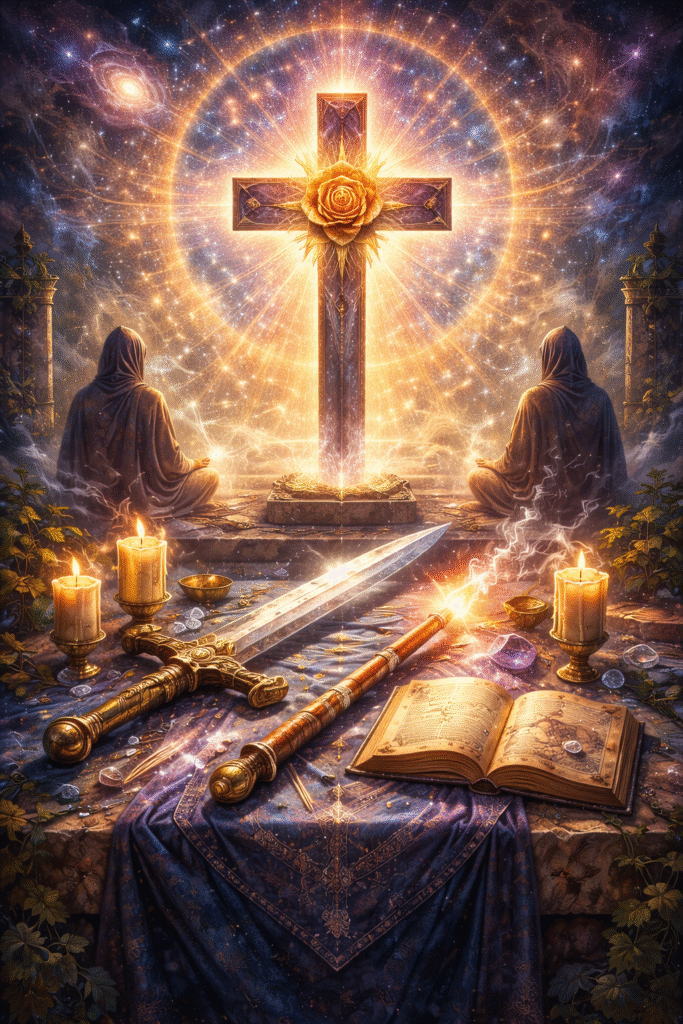
Magical Record, Ritual and Observations
Over the past weeks my days have been particularly full and charged. Many new situations and responsibilities emerged in my daily life, requiring attention, adaptation, and a considerable amount of practical energy. Because of this rhythm, it was not always easy to find the quiet time necessary to properly prepare for the ritual requested in this assignment.
Although I was not able to perform the ritual immediately, I maintained my daily practices. My meditation sessions and energy practices continued each day, even when time was limited. As usual, I preferred to wait until I could approach the ritual with sincerity and proper attention rather than rushing it while my mind was overly occupied with external matters.
Eventually, when a moment of relative calm appeared, I performed the ritual once.
For the symbolic tools, I deliberately chose the Sword and the Wand, as these are instruments that I had crafted myself previously with clear intention. Because they were consciously created for my practice, they already carried a personal significance within my work. Their presence in the ritual therefore felt natural and grounded.
Alongside them, I included the Rosy Cross, which was not physically present but visualized and anchored within the imagination as the central symbol of the ritual.
Before beginning, I spent several minutes in silent meditation in order to quiet the mental activity accumulated throughout the day. Slow breathing and stillness gradually allowed the mind to settle into a more stable state.
Within the imagination I established a simple symbolic temple. At its center stood the Rosy Cross, calm and luminous.
I began the ritual with the Sword. Holding the tool I had crafted, I contemplated it as the instrument of clarity and discernment. In a slow and deliberate gesture, I raised it and imagined drawing its line along the central axis of my body, clearing the path of perception and aligning intention.
After this, I turned to the Wand, which I also held physically. Because it had been consciously crafted for practice, its presence already carried familiarity and meaning. I raised it gently, allowing the gesture to represent the orientation of my will, not as an act of forcing outcomes, but as an alignment with the larger movement of life.
After these gestures, I returned my attention to the Rosy Cross at the center of the imagined space. I remained still, contemplating the intersection it represents.
During the ritual, I imagined myself standing at the center of that cross. I perceived that intersection as the place where opposing movements meet: activity and stillness, creation and dissolution, expansion and contraction. Yet the center itself does not belong to either side. It is simply the point where they cross, where I was standing carrying that spark of opposites.
After some minutes, the ritual concluded naturally in silence. I remained seated briefly before allowing the visualized temple to dissolve.
Observations in the Days Following the Ritual
The days following the ritual returned quickly to the same active rhythm that had characterized the previous weeks. Many responsibilities and new challenges continued to appear within daily life.
Interestingly, rather than feeling separated from the ritual experience, the symbolism of the ritual seemed to appear repeatedly within ordinary situations.
The Sword manifested primarily through moments that required clarity and discernment. Several situations demanded quick decisions or the ability to distinguish what was essential from what was secondary. In those moments, recalling the gesture of the sword seemed to create a brief inner pause, allowing me to approach the situation with clearer perception rather than immediate reaction.
The Wand appeared through the act of directing effort. Each day required initiative and engagement, yet it also became clear that excessive force often complicated matters. When actions felt aligned and intentional rather than rushed, things unfolded more smoothly. In that sense, the wand became a quiet reminder of directed but balanced will.
The presence of the Rosy Cross appeared in a more pervasive way.
For me, this symbol has taken on a very specific meaning through my experience within this school. During the first lecture where the Rosy Cross was introduced and contemplated, I perceived it as the representation of an infinite cycle of creation. It appeared to me as a structure of ever-becoming, a continuous movement where creation begins again and again. In that sense it evoked the image of throwing the dice repeatedly, the eternal return of the creative impulse that expresses itself through existence.
This movement of creation, however, does not feel chaotic. It appears to be animated by Will, and clarified by the action of the Sword, which gives direction and discernment to that impulse.
At the center of the Rosy Cross, where the arms intersect, I perceived what could be described as a chiasma, or a crossroads similar to what was revealed to me in “Crossing the Abyss.”
While reflecting further on this experience, it became clearer to me that the meaning the Rosy Cross holds in my practice is also closely related to this idea of the crossroads.
It is difficult even to describe this strictly in terms of time—whether moments, hours, or days—because the experience feels more like a continuous return to that central point.
Many situations during the day seemed to place me at small crossroads: between acting and waiting, speaking and listening, effort and acceptance, inner reflection and external responsibility. Instead of appearing as contradictions, these moments increasingly resembled intersections of forces.
At times it felt as though daily life itself was presenting a continuous series of such crossings. Standing within these moments required remaining centered within the intersection before immediately leaning toward one side.
At any instant one stands again at that intersection where different possibilities meet. From that center, movement begins again. Action unfolds outward into life, circumstances develop, and eventually one arrives again at another intersection.
Seen from this perspective, the Rosy Cross represents both the center of balance and the origin of new creation.
It is the point where opposites meet, but also the place from which the next movement emerges. Each return to that center feels like the beginning of another cycle of becoming.
In that sense the Rosy Cross is not only the crossroads itself.
It is also the cycle that unfolds from it, the continuous movement of creation returning again and again to its source.